Abercrombie & Fitch (A&F) is an American retailer that focuses on casual wear for teenage consumers. It has over 300 locations in the United States, and is expanding internationally. The company also operates three offshoot brands: Abercrombie kids, Hollister Co., and Gilly Hicks. A&F open its first flagship store in central, Hong Kong on 11 August 2012. The marketing and sales strategy of A&F : appeal to “cool” and “popular” kids to make the brand distinctive and desirable. While the company hired many masculine models to promote their brand images in the opening day, it stir up a upsurge of visiting the store among Hong Kong teenager.
However, Abercrombie & Fitch has released a line of T-shirts depicting Chinese laundry workers and smiling Buddhas in 2004 which captioned by groan-worthy puns. The T-shirts lead to Asian American students protesting the reproduction of century-old caricatures. We can see from the picture above, the T-shirts showed fully Orientalism. Orientalism is first introduced by Edward Said. It is a mythology in which the East and the West were set in opposition and the East was used by the West to define its own, superior identity. It gives us a specific language that governs how we conceive of Asian people and naturalizes our stereotypes.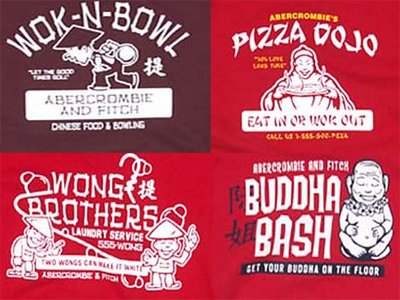
The company's first infamous "Wong Brothers Laundry Service -- Two Wongs Can Make It White" T-shirt is not meant to function as an "accurate" representation of Chinese masculinity but is alluding to the yellow race (Chinese) are mainly doing laundry. Because many of the Chinese immigrants in United States are not highly educated, they can only opened laundries or Chinese food to maintain their livelihood. We can see form the T-shirt pattern, Wong is wearing hats, looks like the style of the stereotype Qing Dynasty in the 19th century, and the role is either cheap labour or laundry staff. It is obviously to satirize the lower class Asian immigrants.Other"orientalism" merchandises like "Get Your Buddha on the Floor" or "Wok-n-Bowl, Let the Good Times Roll -- Chinese Food and Bowling" are also denigrating Asian and trivializing entire Asian religion and philosophy. It shows that western society is superior than asian society.
In the other hand, the offensive caricatures on A&F T-shirts seems have no negative effect in Hong Kong. The teenager in Hong Kong still consume this brand and treat it as an “uniform” that represent stylish. It may means the interpretation of those caricatures are flexible. The asian who might buy them are "whitewashed" or willing to "whitewash" which are affecting by the western advertising or marketing strategy. This above instances also break the hegemony as the caricatures images are not just belong to only one category, there are two : stereotypical (negative) and realistic (positive); and Asian themselves can be either authentic (protesting) or assimilated (buying). If we understand these images as kitsch, we can understand them as a function of marketing strategies such as parody and irony. Otherwise, it is just a kind of racial stereotype.


沒有留言:
張貼留言